Posted on June 26, 2026
"Good health is not created by a single medicine—it is built by a healthy body, balanced lifestyle, and individualized healthcare."
In recent years, interest in homeopathy and immunity has grown significantly. Many people are searching for natural ways to maintain their health, recover from recurrent illnesses, and improve overall well-being. Alongside this growing interest comes an important question:
A qualified homeopathic consultation typically considers:
Because treatment is individualized, two patients with the same diagnosis may receive different homeopathic prescriptions.
What Does Scientific Research Show?
This does not necessarily mean future research cannot provide new insights, but it does mean that stronger, well-designed clinical studies are still needed.
Why Do Some Patients Report Benefits?
What Can We Say with Confidence?
At Vital Homoeos™, we believe that the future of healthcare lies not in choosing one system over another, but in empowering patients with accurate information, compassionate care, and personalized health strategies.
Disclaimer: This article is intended for educational purposes only. It should not replace professional medical advice, diagnosis, or treatment. Always consult a qualified healthcare professional regarding your individual health concerns.
In recent years, interest in homeopathy and immunity has grown significantly. Many people are searching for natural ways to maintain their health, recover from recurrent illnesses, and improve overall well-being. Alongside this growing interest comes an important question:
Does scientific research support the role of homeopathy in immune health?
At Vital Homoeos™, we believe that patients deserve honest, balanced, and evidence-conscious information. Rather than making exaggerated promises, we aim to explain what homeopathy is, what research has explored, and where further scientific investigation is still needed.
Understanding Immunity-
Understanding Immunity-
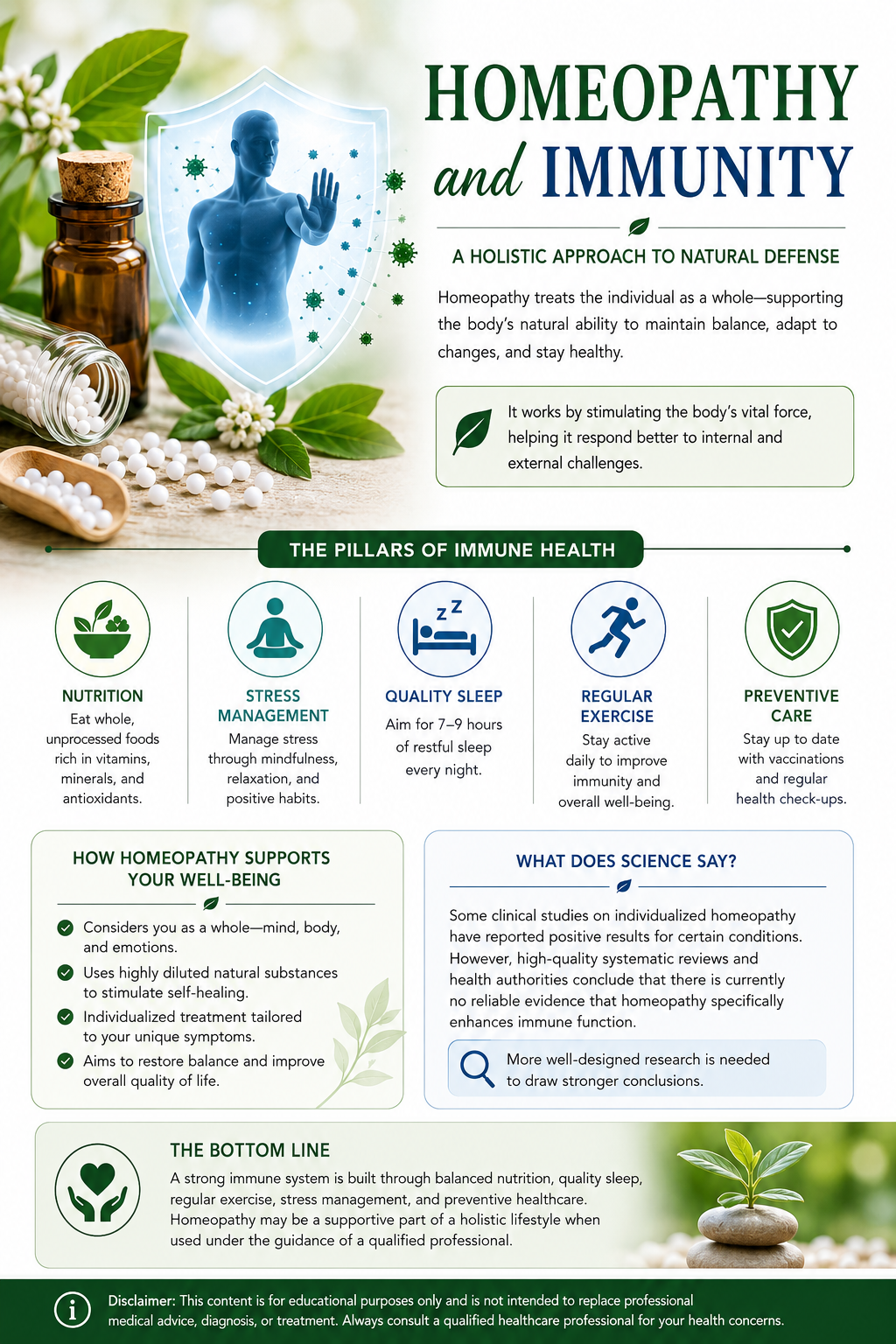
The immune system is the body's natural defense network. It protects us from infections, helps repair damaged tissues, and remembers many harmful microorganisms for future protection.
A healthy immune system depends on multiple factors, including:
Balanced nutrition
Quality sleep
Regular physical activity
Stress management
Healthy gut microbiome
Vaccination where appropriate
Management of chronic illnesses
There is no single medicine or supplement that can instantly "boost" immunity. Instead, immune resilience develops through consistent healthy habits over time.
Where Does Homeopathy Fit?
Homeopathy is a system of medicine developed over 200 years ago by Samuel Hahnemann. Unlike conventional approaches that often focus primarily on disease diagnosis, classical homeopathy emphasizes individualized patient care.
A qualified homeopathic consultation typically considers:
Physical symptoms
Emotional well-being
Sleep patterns
Lifestyle
Personal medical history
Individual symptom characteristics
Because treatment is individualized, two patients with the same diagnosis may receive different homeopathic prescriptions.
For many patients, this comprehensive consultation itself is valued as part of a holistic approach to healthcare.
What Does Scientific Research Show?
This is where honesty is essential.
Over the past several decades, researchers have conducted observational studies, randomized clinical trials, systematic reviews, and meta-analyses investigating homeopathy for a variety of health conditions.
Some individual studies—particularly involving individualized homeopathy—have reported positive findings. However, many of these studies have been limited by small sample sizes, methodological weaknesses, or inconsistent results.
When researchers combine the highest-quality evidence through systematic reviews and meta-analyses, the overall conclusion has generally been that there is currently no reliable evidence demonstrating that homeopathic medicines specifically enhance immune function or work beyond placebo for improving immunity.
This does not necessarily mean future research cannot provide new insights, but it does mean that stronger, well-designed clinical studies are still needed.
Why Do Some Patients Report Benefits?
Despite the uncertainty in the research literature, many patients describe improvements after individualized homeopathic care.
Several factors may contribute to these experiences, including:
Detailed and empathetic consultations.
Greater attention to lifestyle and overall health.
Improved treatment adherence.
The natural course of certain illnesses.
Placebo and contextual effects.
Individual patient expectations.
Researchers continue to investigate how these factors may influence health outcomes.
Homeopathy as Part of Holistic Healthcare
Many people choose homeopathy as one component of a broader wellness strategy.
At Vital Homoeos™, our philosophy is that long-term health is built through:
Individualized patient assessment.
Healthy nutrition.
Regular exercise.
Quality sleep.
Stress reduction.
Preventive healthcare.
Appropriate medical evaluation when required.
Collaborative, patient-centered care.
Homeopathy should not replace evidence-based emergency treatment, vaccination programs, or essential conventional medical care for serious illnesses. Instead, it may be considered—after discussion with a qualified healthcare professional—as part of an overall approach to supporting health and well-being.
What Can We Say with Confidence?
Current scientific evidence strongly supports the following for maintaining a healthy immune system:
✔ Regular physical activity.
✔ Balanced nutrition.
✔ Adequate sleep.
✔ Stress management.
✔ Smoking cessation.
✔ Maintaining a healthy body weight.
✔ Vaccination according to medical
recommendations.
recommendations.
Regarding homeopathy, current research presents a more nuanced picture. Some studies have reported encouraging findings, particularly for individualized treatment approaches, while high-quality systematic reviews have not established specific immune-enhancing effects. This is an active area of ongoing research that requires further well-designed clinical trials.
The Vital Homoeos™ Perspective
At Vital Homoeos™, we believe trust is built through honesty.
We do not believe healthcare should rely on exaggerated claims or unrealistic promises.
Instead, we are committed to:
Individualized patient care.
Ethical clinical practice.
Patient education.
Holistic lifestyle guidance.
Scientific curiosity.
Continuous learning.
Our goal is not simply to treat symptoms but to help patients make informed decisions that support their overall health and quality of life.
Final Thoughts
The relationship between homeopathy and immunity remains an area of ongoing scientific interest.
While current high-quality evidence has not established that homeopathic medicines specifically improve immune function, many patients continue to value individualized homeopathic consultations as part of a holistic approach to wellness.
Maintaining a healthy immune system ultimately depends on a combination of healthy lifestyle choices, preventive healthcare, appropriate medical guidance, and informed decision-making.
At Vital Homoeos™, we believe that the future of healthcare lies not in choosing one system over another, but in empowering patients with accurate information, compassionate care, and personalized health strategies.
Disclaimer: This article is intended for educational purposes only. It should not replace professional medical advice, diagnosis, or treatment. Always consult a qualified healthcare professional regarding your individual health concerns.
Make An Appointment
If you have any questions call us on +918104555000